
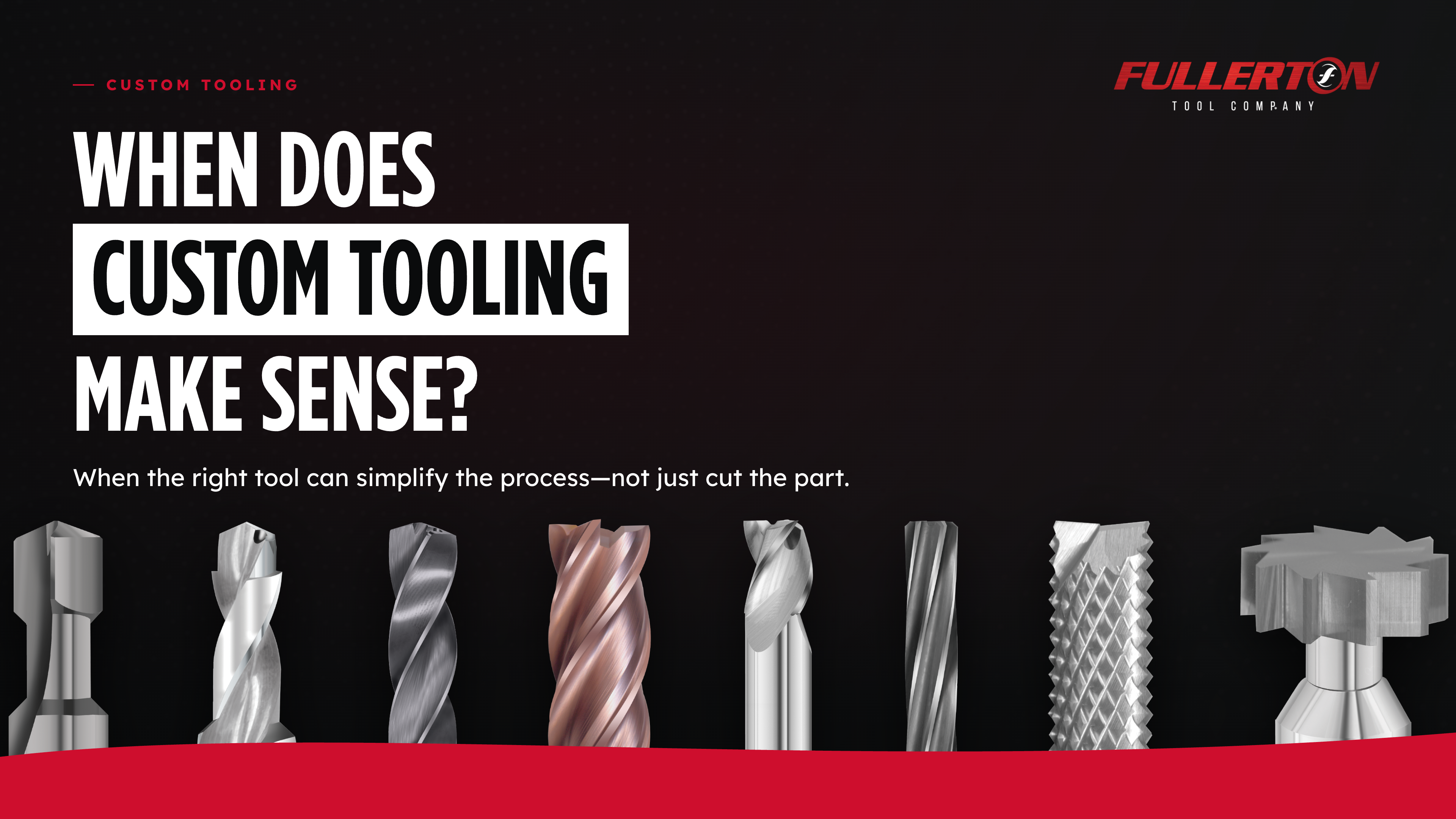
Standard tooling gets a lot of jobs done - and when it does great.
But sometimes getting the job done isn't the same as getting it done efficiently.
Multiple tools. Extra tool changes. Longer cycle times. Secondary operations. Inconsistent tool life. Those little inefficiencies can add up quickly when you're making hundreds - or thousands - of parts.
That's where custom tooling starts to make a lot of sense.
A custom cutting tool isn't about making something different just for the sake of being different. It's about looking at the entire application and asking a better question:
Can we make this part faster, more consistently, or with fewer tools?
Very often, the answer is yes.
When Is It Time to Consider Custom Tooling?
Not every application needs a custom tool.
If a standard end mill, drill, reamer, or saw is doing exactly what you need it to do, keep making chips.
But custom tooling is worth a conversation when you're dealing with:
- Multiple tools performing separate operations
- Frequent tool changes
- Long cycle times
- Difficult features or part geometries
- Tool life that isn't where it needs to be
- Tight tolerances or finish requirements
- High-volume production where seconds matter
- An "almost right" standard tool that's creating other problems
The question isn't simply "How much does the tool cost?"
It's "How much does it cost to make the part?"
And that's a very different conversation.
One Tool Can Replace Multiple Operations
One of the biggest opportunities with custom tooling is operation consolidation.
Instead of drilling a feature, changing tools, chamfering it, changing tools again, and moving on to the next operation, a custom combination tool may be able to perform several of those operations at once.
That can mean fewer tool changes, fewer operations, less cycle time, and more parts out the door.
Depending on the application, it can also free up machine capacity.
We've seen this firsthand.
In one application with Griner Engineer, a custom tooling solution helped move production from requiring three machines down to two.
That's bigger than saving a few dollars on a cutting tool. You're changing the economics of the entire process.
A More Expensive Tool Can Make a Less Expensive Part
It's easy to compare two cutting tools based on purchase price.
Tool A costs $50
Tool B costs $150
Easy decision, right?
Not necessarily.
What if Tool B lasts longer? Eliminates another tool entirely? Saves 30 seconds per part? Keeps the operator from stopping the machine as often as tool changes?
Suddenly, that $150 tool starts looking a lot different.
One Fullerton custom saw application resulted in approximately $177,000 in annual savings.
In another application, a tooling solution delivered up to 3.48x more parts per tool while reducing time per part by 78%.
That's why we like to look beyond cost per tool and start talking about cost per part.
Custom Doesn't Have to Mean Complicated
Sometimes customers hear "custom cutting tool" and immediately picture a long, complicated process.
It doesn't have to be.
You don't need to show up with the perfect tool design. That's our job.
Bring us your:
- Part print
- Material
- Current tooling/process
- Speeds and feeds
- Tool life
- Cycle time
- Problem you're trying to solve
From there, our team can look at the application and determine where there may be opportunities to improve the process.
Sometimes that's a fully custom tool. Sometimes it's a combination or form tool. Sometimes it's a coolant-thru solution.
And sometimes we may determine that you don't need custom tooling at all.
The goal isn't to sell you a custom tool. It's to find the right tool for the job.
Start with the Application
The best custom tooling conversations usually don't start with:
"Can you make this tool?"
They start with:
"Here's what we're trying to accomplish."
Tell us about the part, what's working, what's not, and where you're losing time or money. We'll help determine whether there's an opportunity to combine operations, improve tool life, reduce cycle time, or simply make the process more predictable.
Because sometimes the best way to make more parts isn't another machine.
It's one smarter tool.
Talk to Us About Your Application by filling out the form below.